

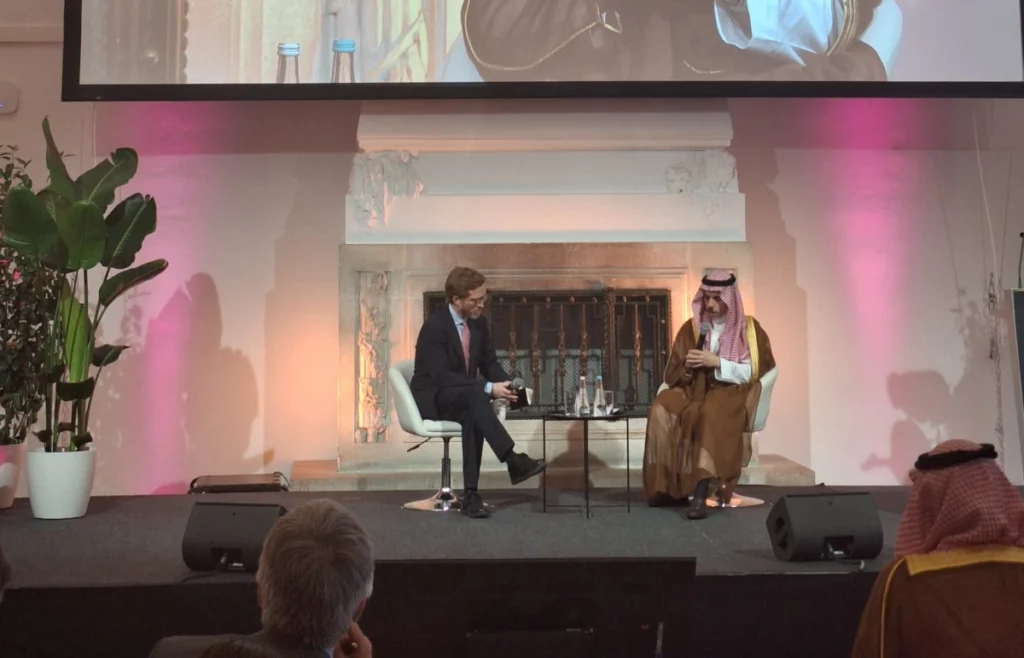
VIENNA — Saudi Foreign Minister Prince Faisal bin Farhan expressed optimism about the emerging US-Iran agreement. He said the deal could help end the recent conflict and open the door to a broader regional security framework.
Speaking during a session hosted by the European Council on Foreign Relations (ECFR) in Vienna on Wednesday, Prince Faisal described the memorandum of understanding (MOU) expected to be signed later this week as a significant development for the region.
“I think it’s incredibly important and very significant that we have an MOU that will hopefully put an end to this conflict and, more importantly, open the pathway towards resolving many of the outstanding issues,” he said. “Primary among them, of course, is the nuclear issue.”
Verification key to lasting agreement
Prince Faisal said he was hopeful that both Washington and Tehran were prepared to give diplomacy a genuine chance.
“I am hopeful, I am optimistic that there is real intent on both sides to give diplomacy a chance,” he said, while praising US President Donald Trump and his team for bringing the process to the point of an agreement.
The minister stressed that the success of any future agreement would depend on strong verification measures and long-term safeguards.
“The detail will matter,” he said. “How we will have a long-term sustainable verification regime is what will matter the most.”
He said such mechanisms would provide confidence to regional countries and the wider international community.
Prince Faisal also highlighted the need to address freedom of navigation in the Strait of Hormuz and broader regional security concerns.
Trust with Iran must be rebuilt
Asked about reports of a proposed $300 billion reconstruction or investment fund for Iran, Prince Faisal said he had no information about the fund and therefore could not comment on its specifics.
“First of all, I have no details on this fund. I have no information or insight into the concept behind it, so I can’t comment on it specifically,” he said.
The minister noted that recent Iranian attacks on Gulf countries had significantly damaged trust and complicated prospects for future economic engagement.
“Iran attacked not just the Kingdom but all of the countries of the GCC,” he said. “That has created a significant loss of trust between all of us.”
Prince Faisal said relations between Saudi Arabia and Iran had only recently begun improving following the Beijing understanding before the conflict reversed much of that progress.
“We were just in the beginning process of rebuilding our relationship with Iran,” he said.
“We were starting to gather momentum and were starting to explore potential areas of economic cooperation. We are now actually regressed.”
He noted that Saudi Arabia’s Public Investment Fund (PIF) is already focused on long-term domestic priorities and major national projects.
“We in the Kingdom have a very ambitious domestic investment program,” he said. “Our Public Investment Fund, our main vehicle for investment, has a long-term strategy that was actually just approved.”
Prince Faisal said the fund’s investment streams have already been committed to areas supporting the Kingdom’s domestic economy.
“They have already committed their funding streams to areas that are targeted at our domestic economy.”
He added that any future investment decisions would be up to the relevant economic and investment authorities.
“Whether there is anything available to invest beyond that is something that I don’t know,” he said. “That’s up to the relevant ministers on the investment side and on the economic side.”
Prince Faisal stressed that rebuilding trust and relations must come first before discussing major economic cooperation with Iran.
“Before we can look at that as an option, there’s going to have to be a rebuilding of trust and a rebuilding of relationships,” he said.
“Then maybe there is eventually in the future some pathway to greater economic cooperation and investment between Iran and the Kingdom and the GCC.”
He said that, before the conflict, Saudi Arabia had begun taking gradual steps toward normalizing relations with Iran.
“We had started gradually opening up for visitors from Iran and starting to look at reopening trade relations,” he said.
Prince Faisal added that the conflict had reversed much of that progress and that rebuilding confidence would be a prerequisite for any future economic partnership.
Kingdom played supportive role
Asked about Saudi Arabia’s role in the diplomatic efforts, Prince Faisal said the Kingdom had acted mainly as a supporter rather than a mediator.
“We were supporters and we were helpful behind the scenes in trying to encourage both parties to give primary focus to the diplomatic track,” he said.
He said Saudi Arabia would continue supporting efforts aimed at resolving regional disputes and strengthening long-term stability.
Prince Faisal also stressed the importance of ensuring that Iran’s civilian nuclear program poses no threat to neighboring countries.
“Ensuring that there is a civilian nuclear program in Iran that is not a risk to its neighbors is critically important,” he said.
“I’m certainly going to be very vocal in advocating for ensuring that whatever agreement is reached is a solid agreement that has the necessary safeguards and the necessary verification mechanisms.”
Diplomacy and deterrence must go together
Prince Faisal said Saudi Arabia would continue pursuing diplomacy while strengthening its defense capabilities.
“The reality is you can’t have effective diplomacy without a strong deterrent and a strong resilience to be able to deal with potential threats and challenges,” he said.
He described the Kingdom’s approach as a dual-track strategy that combines security preparedness with active diplomatic engagement.
“We are committed to diplomacy,” he said. “We will work with our partners in the region to begin a regional dialogue.”
Regional issues cannot be ignored
Prince Faisal warned against limiting negotiations solely to the nuclear file.
He said lessons from the 2015 nuclear agreement showed that broader regional concerns must also be addressed.
“One of the lessons that we learned from the JCPOA, which also ignored the regional context completely, is that if we don’t address the issues that concern the region, the risk is always that any agreement on the nuclear issue becomes less secure,” he said.
The minister said progress on regional issues would help build confidence and improve prospects for future sanctions relief.
“The more that the regional issues are addressed and there is a level of confidence that we are able to look towards a future where there is less risk of confrontation, the more likely it is that the potential benefits in the areas of sanctions relief can be delivered more quickly and more effectively,” he said.
Palestinian issue remains central
Asked about the future of regional dialogue and Israel’s place in such discussions, Prince Faisal said any durable framework must also include Palestinians.
“The core issue, the thing that drives most risk in the long term, is obviously the unaddressed issue of the rights of the Palestinians,” he said.
“Israel is part of the region. That means they should be part of the regional conversation, but Palestine is also part of the region. They need to be part of that conversation.”
Military solutions alone will not work
Prince Faisal said relying solely on military action would not bring lasting stability to the region.
“For Israel to insist solely on the military approach in the long term will be very detrimental to Israel’s interest,” he said.
“The idea that a purely military approach is viable in the long term is completely incorrect and is not going to be in the interest of anyone.”
Discussing Gaza, Prince Faisal said the biggest obstacle remained the absence of a political track.
“The biggest challenge for Gaza is Israel’s unwillingness so far to embrace the political track and the need for a political horizon for the Palestinians,” he said.
He said both Israel and Hamas must fulfill their commitments and move toward a political process.
“There is a need for both sides to live up to their commitments. Right now, both sides are not living up to the commitments,” he said.
Status quo must return in Hormuz
On the future of navigation through the Strait of Hormuz, Prince Faisal said Saudi Arabia’s position was clear. “The situation must return to the status quo before the war,” he said.
He rejected suggestions of new arrangements or fees for maritime traffic through the strategic waterway.
“The management of the strait was working fine before the conflict. There were no issues. Ships were navigating freely.”
“Why should we now, as a result of a conflict, accept some novel arrangement that is going to be imposed on it?” he asked.
Europe still has a role to play
Prince Faisal dismissed suggestions that Europe had been sidelined during the crisis.
“Europe did step up,” he said, noting European support for Gulf security and diplomatic efforts during the conflict.
He pointed to European involvement in maritime security efforts and preparations for a mission aimed at safeguarding navigation in the Strait of Hormuz.
He said European countries could also contribute through sanctions discussions and their experience on the nuclear file.
“Europe has a role to play and I think Europe can play that role,” he said.
“I would not at all minimize the role that Europe has already played and can play in the future.”
Source: Saudi Gazette