

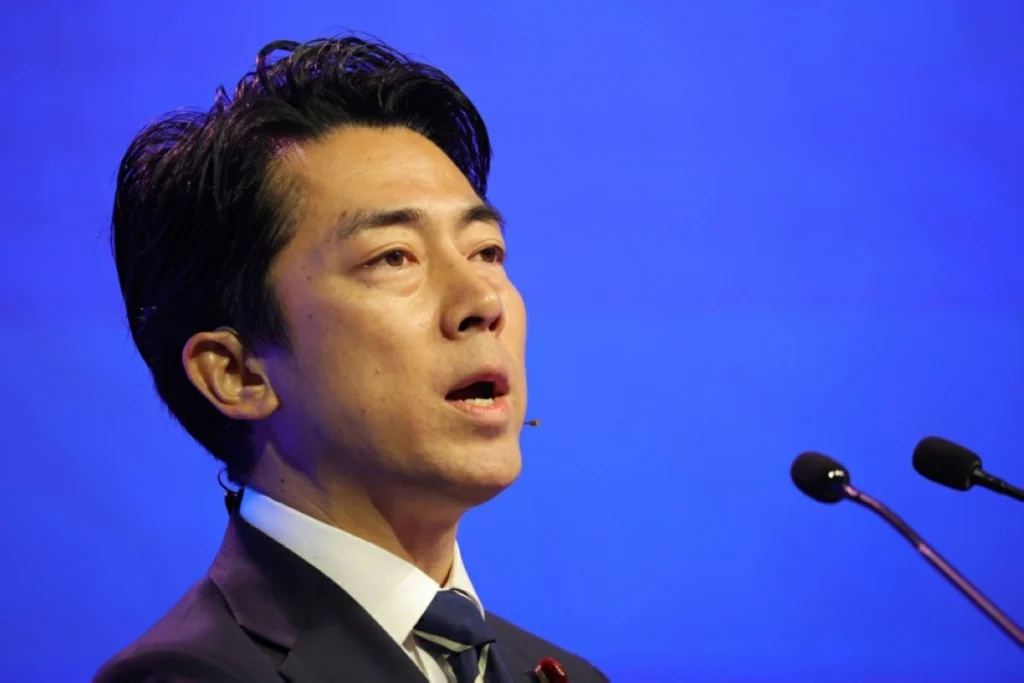
TOKYO —Japan’s Defense Minister Shinjiro Koizumi has said his country must “strengthen its defense capabilities” and questioned the accuracy of China’s official military spending figures in a fresh sign that Tokyo is taking a tougher line in response to Beijing’s claims that its regional rival is pursuing “new militarism.”
Drawing a contrast with China, Koizumi said Japan would take a transparent approach to investing in new methods of warfare like drones and artificial intelligence that are needed to keep up with the changing nature of conflict.
“Our budgets undergo scrutiny and deliberation in parliament,” Koizumi told Bloomberg on Wednesday. “Are the figures they put forward genuinely grounded in fact, backed by evidence, and highly transparent? When doubts arise on those points, how much effort do they put into explaining them?”
Japan must “strengthen its defense capabilities”, Koizumi said, emphasizing the need to revisit the pacifist posture that has defined the country since World War Two.
He said boosting defense, “reinforcing its alliance with the United States, and expanding collaboration with like-minded countries” was part of “building multi-layered deterrence critical for ensuring that no new war breaks out in this region”.
China has emerged as a formidable global player, and North Korea’s nuclear ambitions, which have seen it test-fire ballistic missiles over Japan, show no signs of slowing down.
Japan’s Defense Ministry identified China’s military moves as the “greatest strategic challenge” in its latest white paper report submitted to Cabinet.
Last month, Koizumi rebutted Beijing’s claim that his country was engaging in a “new militarism” and argued it was China and its “huge arsenal” of weapons that was of “serious concern” to the international community.
But Japan is keen to keep talking to Beijing, Koizumi insisted.
“I met with my China counterpart in November of last year. Because there are areas where our views differ, I conveyed my desire that we continue engaging in dialogue,” he said.
“Unfortunately, there have not been many opportunities for direct communication recently. However, as I stated at the Shangri-La Dialogue, Japan is always open to dialogue. We will continue sending that message and hope that opportunities for dialogue can be created whenever necessary.”
Koizumi spoke of the recent changes in Japan’s defense policy, such as relaxing decades-old arms export rules.
For the first time in about 50 years, Tokyo can now sell or transfer defence equipment and lethal weapons to the 17 countries with which it has signed formal agreements, including the US and the UK.
“Australia has selected Japanese war ships. Discussions are under way with the Philippines for used destroyers from Japan’s Maritime Self-Defense Force. We are in deep talks with Indonesia, and New Zealand has also showed interest in acquiring Japanese destroyers,” Koizumi explained in an interview with BBC at his office in Tokyo.
“This vision of trading equipment and assets throughout the Indo-Pacific is something we have never seen before.”
Prime Minister Sanae Takaichi, who came to power in October 2025, has also pushed for revising Article 9 of Japan’s constitution, which renounces war as a sovereign right of the nation and the threat or use of force as means of settling international disputes. It also states that land, sea, and air forces, as well as other war potential, will never be maintained.
Koizumi said he supported a revision to Article 9 because of how the region has changed over the past eight decades.
Koizumi, 45, also said Japan needed to clarify the status of the SDF or Self-Defence Forces. Legally and politically, Japan doesn’t call it a military — although operationally it functions as one.
“The SDF should be able to carry out its mission with pride and honour, and Japan must possess defense capabilities that remain steadfast even in today’s challenging security environment,” he added.
Critics have said that formally recognising or expanding the SDF could threaten the pacifist stance of Article 9. Some even argue it doesn’t stand in the way of the government’s objectives.
“We don’t need to amend Article 9 for defensive operations against China. So it’s more a political agenda than something based on military rationality,” says Hirohito Ogi, a senior research fellow at the Institute of Geoeconomics, studying military strategy and defence policy.
Established after WWII, the US-Japan security alliance remains the cornerstone of Japan’s defense. Japan hosts the largest overseas deployment of US forces in the world, with 50,000 or so troops based in the country.
But more recently, US leaders, and President Trump in his second term particularly, have emphasised burden-sharing, suggesting that allies should spend more on their own defense.
“The era of the United States subsidising the defence of wealthy nations is over,” Defense Secretary Pete Hegseth said last month during his keynote address at the Shangri-La Dialogue.
Takaichi, known for her hawkish national security stance, has raised defense spending to 2% of GDP, which is double the long-standing post-war benchmark.
Japan plans to invest its increased military budget in new surface-to-ship missiles and unmanned drones deployed on land and underwater.
Some analysts say Japanese industry, such as shipbuilding and electronic systems, could become increasingly competitive in the global defense market.
The emergence of true Japanese defence firms, focused at least primarily on the sector, will be critical to success, according to the Center for Strategic and International Studies.
In line with the US view, Koizumi believes Japan should play a key role in maintaining security in the region.
“Japan can make contributions to the region that are uniquely Japanese — not solely through our relationship with the US, but also in our own independent role,” he said.
Source: Saudi Gazette