

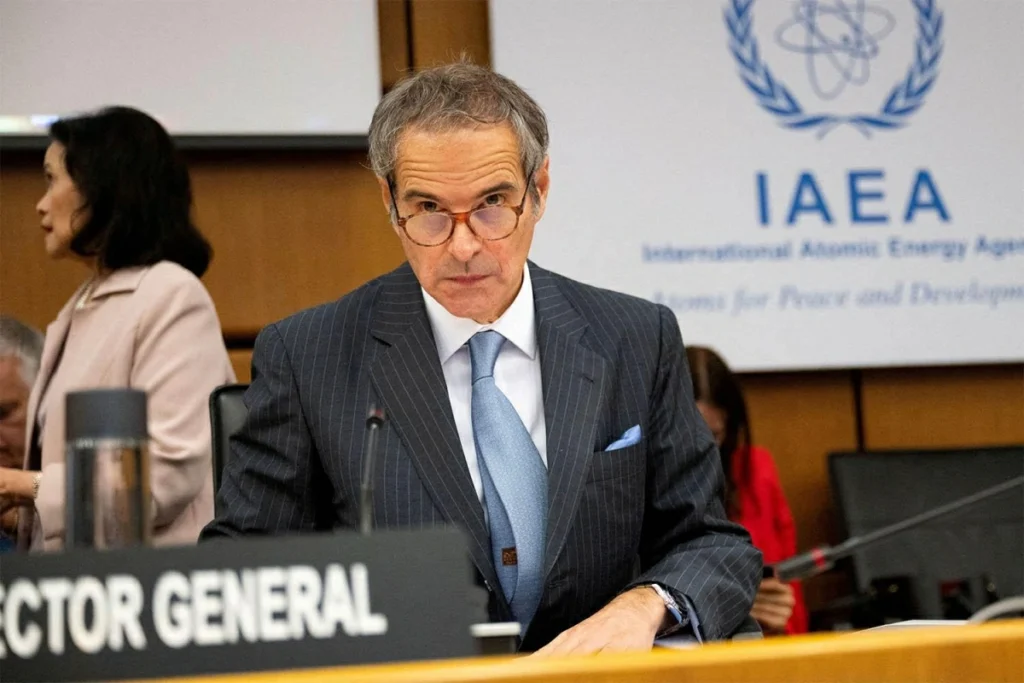
GENEVA — The head of the UN nuclear watchdog on Thursday welcomed the interim peace deal signed by Washington and Iran, saying it would now be involved in technical discussions to implement the agreement.
“We believe the fact that the indispensable role of the IAEA is recognized is a sound point of departure,” said Rafael Grossi, director general of the International Atomic Energy Agency, in reference to the reported text of the memorandum.
“Now it’s for us to sit down with our American colleagues, our Iranian colleagues and start formulating the concrete steps that will have to be taken. So, I think it’s good that the memorandum is there. Now the technical work starts,” Grossi told reporters in Geneva.
The 14-point agreement signed on Wednesday evening extends a ceasefire announced in April by another 60 days, including in Lebanon, to allow the two sides to negotiate a final truce.
Both Trump and Iranian President Masoud Pezeshkian have digitally signed the memorandum, US and Iran officials said, with Iran’s foreign ministry saying the agreement was already in effect as of Wednesday.
According to media reports, the memorandum of understanding provides for a maximum of 60 days of negotiations to achieve a “final deal” on issues including uranium enrichment by Iran which must also reaffirm that it does not intend to develop a nuclear weapon.
“The fact that they are mentioning that this will be under the supervision and control of the IAEA is very important, because in our conversation, what we are going to be doing is defining what we need to see, what we need to access,” Grossi said.
He said the magnitude of the IAEA’s work will be determined by the final provisions of the agreement, and that technical talks would seek to break down the general principles.
Responding to a question about a possible agreed reduction in the level of uranium enrichment by Iran, the IAEA chief noted that “many, many possibilities” could be explored.
“There are many different alternatives…There are different ranges of enrichment in the current Iranian inventory and we will see what is agreed,” he said.
The agency’s access to all of Iran’s nuclear facilities is “not at a level and in all the locations it should be”, he stressed, but contact with the authorities is ongoing and the agency has “a pretty good idea” of the “specific things, places, that we need to access”.
Grossi refused to speculate about spoilers “because we are about to start and we have to initiate any negotiation on the assumption that we are all in with faith, that we want to be successful”.
Grossi added: “It’s now, I’d say, that the technical work can start for real.”
In February Iran and the US failed to reach a breakthrough in talks in Geneva aimed at resolving their longstanding nuclear dispute, though the Omani mediator said progress had been made, and technical talks were due to take place the following week with the IAEA in Vienna.
However 48 hours later the US and Israel launched strikes on Iran which sparked a regional war.
“We have a chance and we need to seize it,” Grossi said.
Source: Saudi Gazette