

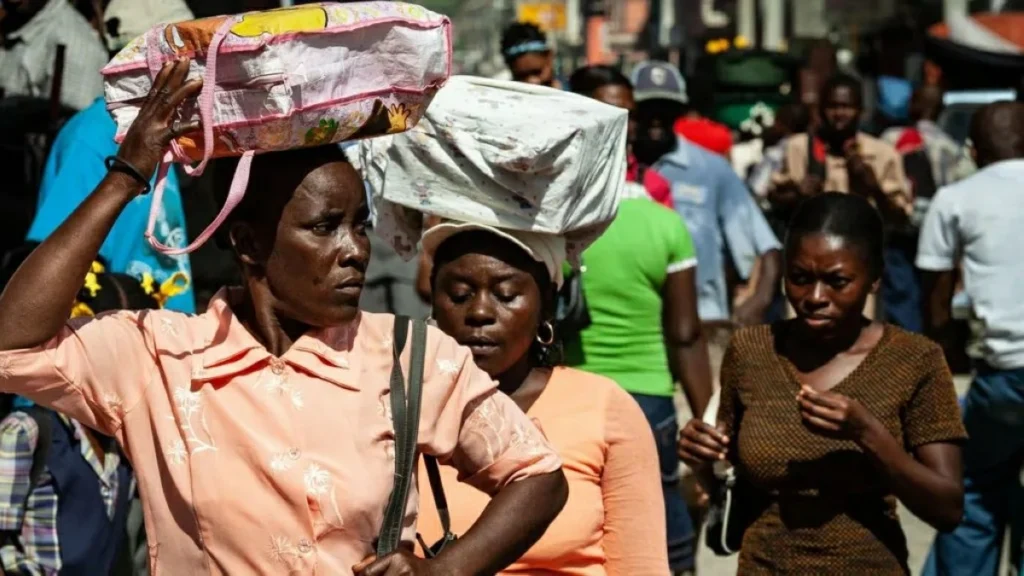
WASHINGTON — The US supreme court on Thursday ruled in favor of the Trump administration’s bid to strip temporary protected status from hundreds of thousands of Haitian and Syrian migrants which allowed them to stay legally in the US for years with protection from deportation.
The court issued a 6-3 ruling overturning decisions by federal judges in New York and Washington that had halted the administration’s actions terminating TPS for more than 350,000 migrants from Haiti and 6,100 from Syria.
The court’s three liberal-leaning justices disagreed with the opinion. It leaves Haitians and Syrians in the US on TPS vulnerable to deportation even if they have applications for other forms of immigration status in progress.
The state department currently warns against traveling to either Haiti or Syria, citing widespread violence, crime, terrorism and kidnapping.
All countries with a designation allowing TPS in the US are now considered under threat as the ruling will embolden the US president to strip other places of their status, no matter how risky it would be for immigrants to return home.
TPS is granted to individuals whose home countries are unable to accommodate them, due to war or natural disasters.
In a separate ruling, the court has said that migrants arriving at the border are not entitled to apply for asylum until they set foot on US soil, giving another win to the Trump administration.
TPS recipients can legally live and work in the US for up to 18 months, subject to extensions. During this period, they can not be removed or detained by authorities on the basis of their immigration status.
The US first provided TPS to Haitians after a major earthquake in 2010 and to Syrians after their country descended into civil war in 2012.
In his ruling, Justice Samuel Alito wrote that the law governing TPS clearly prevents courts from reviewing government decisions.
Justice Alito also said the Haitian migrants who sued were unlikely to prove that the administration’s actions were racially discriminatory and violated US constitution’s equal-protection rights under the Fifth Amendment.
Justice Elena Kagan, one of the dissenting judges, said that the government’s decision to remove these protections were racially motivated.
“The statements fairly shout, in their racial undertones and overtones alike, that race entered into the President’s resolve to remove Haitians from this country,” she said.
The Trump administration welcomed the ruling.
“The T in TPS stands for TEMPORARY, yet many of these designations became de facto amnesty,” James Percival, the general counsel for the Department of Homeland Security, said on X after the ruling.
“This is a win for the rule of law and common sense.”
During his 2024 presidential campaign, Trump amplified false rumors about Haitian immigrants, including that they were abducting and eating house pets.
With this ruling, the court has now cleared the way for the Trump administration to remove legal protections for TPS recipients, meaning they could face deportation.
“Today’s decision puts hundreds of thousands of people at risk”, said Jill Habig, CEO and Founder of Public Rights Project, which filed amicus briefs on behalf of 47 local governments and leaders, urging the Supreme Court to preserve TPS for Haitian immigrants.
The local fallout of the ruling will result in a community crisis, she said.
“Families will be separated, local economies will take a hit and people will be forced back to countries in the grip of violence, instability and humanitarian collapse,” Habig said. “The human cost will be felt all across America.”
The court backed the Trump administration in another immigration related ruling on Thursday.
In the 6-3 ruling, the court has said the Trump administration can turn away migrants seeking asylum along the US-Mexico border if they have not set foot on US soil.
Under federal law, a migrant who “arrives” in the US may apply for asylum, which the Trump administration had argued ruled out those stopped on the Mexican side of the border.
When this case reached the Supreme Court in March, arguments focused on what it means to arrive in the US.
Vivek Suri, an assistant to the solicitor general, told the court: “You can’t arrive in the United States while you’re still standing in Mexico. That should be the end of this case.”
A lawyer for an immigrant advocacy group had argued that asylum seekers arrive in the US when they reach a port of entry.
Justice Sonia Maria Sotomayor, who voted against the ruling, called the consequences of the court’s decision “predictable” in her dissent.
“More people will die,” she said. “More people will attempt to cross the border illegally, and some will make it while others will not.”
The requirement to be physically present in the US to apply for asylum was first introduced in 2016 during the Obama administration.
The policy, called “metering” was put in place to allow border control agents to limit the number of asylum seekers allowed to request protection each day on the grounds that the facilities on the US side of a border crossing area were at capacity.
The court’s ruling has allowed Trump, a Republican, to revive the 2016 policy which was rescinded in 2021 under the Democratic administration of President Joe Biden.
Source: Saudi Gazette