
Close Menu

    Subscribe to Updates

    Get the latest creative news from FooBar about art, design and business.

    What's Hot

    Saudi Defense Ministry relaunches overseas military scholarship program

    July 6, 2026

    Iron deficiency affects up to 30% of children, UAE doctors warn

    July 6, 2026

    Earth reaches farthest point from Sun Monday night

    July 6, 2026
    Facebook X (Twitter) Instagram
    Riyadh Week
    • Home
    • KSA
    • Business
    • Technology
    • Sports
    • Lifestyle
    Facebook X (Twitter) Instagram YouTube
    Riyadh Week
    Home»Sports»Earth reaches farthest point from Sun Monday night
    Sports

    Earth reaches farthest point from Sun Monday night

    Editorial TeamBy Editorial TeamJuly 6, 2026
    Share Facebook Twitter Pinterest Copy Link LinkedIn Tumblr Email
    Share
    Facebook Twitter LinkedIn Pinterest Email Copy Link


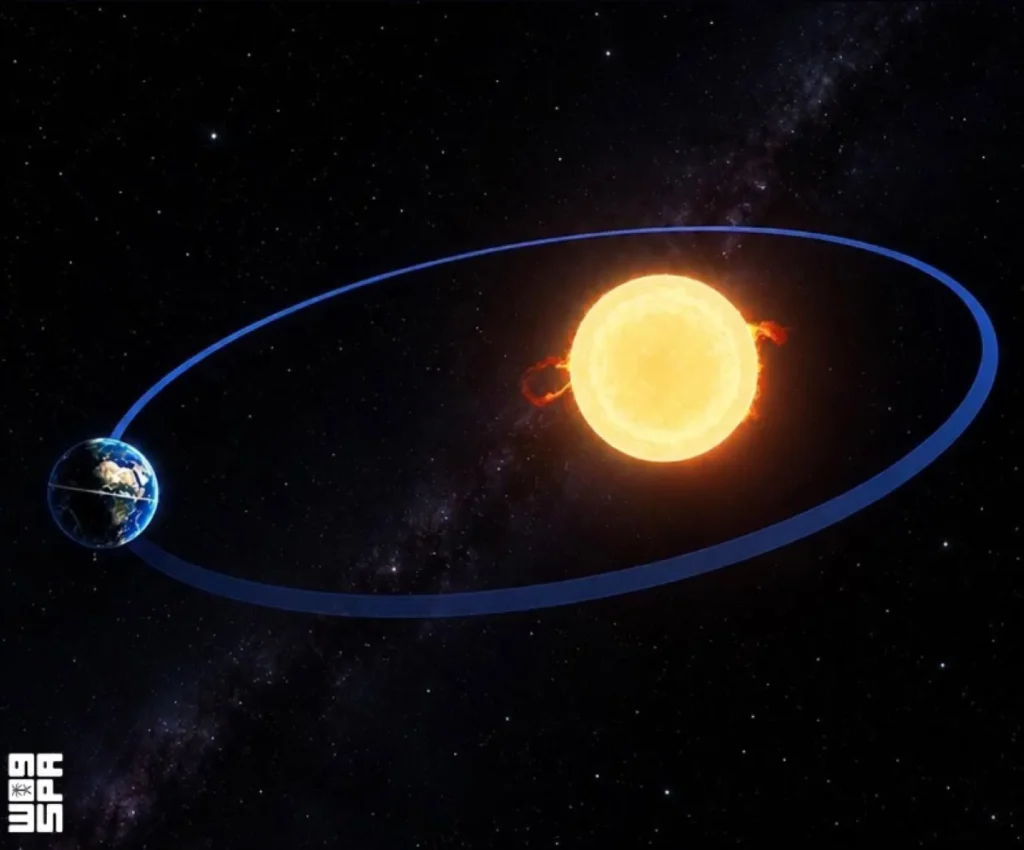
    JEDDAH — Earth will reach aphelion Monday night, its farthest point from the Sun in its annual orbit, at 8:30 p.m. Makkah time, according to the Jeddah Astronomical Society.

    The distance between the Earth and the Sun will be approximately 152 million kilometers.

    The annual astronomical event confirms that the changing of the seasons is determined by the Earth’s axial tilt rather than its distance from the Sun.

    Majed Abu Zahra, President of the Jeddah Astronomical Society, said that reaching aphelion does not result in lower temperatures, as the seasons are governed not by the Earth’s distance from the Sun but by its 23.4-degree axial tilt, which causes the Northern Hemisphere to receive the Sun’s rays at a steeper angle during summer.

    He noted that the Earth travels more slowly in its orbit at aphelion, making summer in the Northern Hemisphere slightly longer than winter.

    Abu Zahra added that the Earth’s orbit is elliptical, causing its distance from the Sun to vary by about 5 million kilometers over the course of a year.

    As a result, the Sun appears slightly smaller at aphelion than at perihelion, although the difference is not visible to the naked eye.

    These phenomena, according to Abu Zhara, are part of the Earth’s natural orbital variations, which help scientists better understand climate patterns and the evolution of the seasons over time.

    Source: Saudi Gazette

    Related Posts

    Millions of mourners fill Tehran streets for Khamenei’s funeral procession

    July 6, 2026

    GASTAT launches survey to measure Saudi Arabia’s digital economy

    July 6, 2026

    Houthis kill 16 Yemeni government soldiers in fiercest clashes in years

    July 6, 2026
    Top Posts

    QBS Software Middle East embeds AI into core operations

    April 1, 2026

    Bosnia’s Barbarez cool as ice after reaching World Cup in shootout with Italy

    April 1, 2026

    Kuwaiti tanker hit by Iranian drone attack in Dubai waters

    April 1, 2026

    UAE designers turn jewellery into meaningful Eid gifts

    April 1, 2026
    Don't Miss

    Saudi Defense Ministry relaunches overseas military scholarship program

    By Editorial TeamJuly 6, 2026

    RIYADH — Saudi Arabia’s Ministry of Defense has relaunched its overseas military scholarship program with…

    Iron deficiency affects up to 30% of children, UAE doctors warn

    July 6, 2026

    Earth reaches farthest point from Sun Monday night

    July 6, 2026

    HRH the Crown Prince Congratulates President of Comoros on Independence Day

    July 6, 2026
    • KSA
    • Business
    • Technology
    • Lifestyle
    • Sports
    2026. All rights reserved.

    Type above and press Enter to search. Press Esc to cancel.