

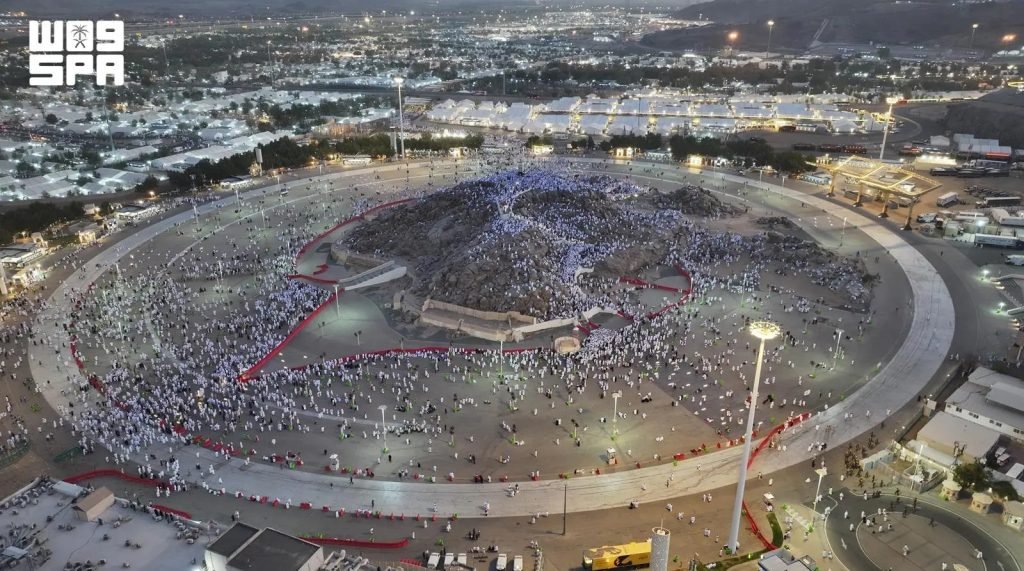
Each year during Hajj, the Holy Sites undergo a remarkable transformation, emerging within days as one of the world’s largest seasonal smart cities capable of accommodating millions of pilgrims through vast networks of energy, water, transport, communications, and digital services.
Behind the scenes, an around-the-clock infrastructure system operated by government and service agencies manages crowds, ensures smooth mobility, and maintains high standards of safety and comfort for pilgrims, before the sites return to their usual calm following the end of Hajj rituals.
Kidana Development Company, the executive arm of the Royal Commission for Makkah City and Holy Sites, continues to implement infrastructure and operational projects to enhance services and ensure sustainable performance throughout the Hajj season.
Projects include cooling and shading the area surrounding Jabal Al-Rahmah (Mount Arafat) across more than 392,000 square meters, increasing the number of benefiting pilgrims fivefold compared with last year.
In healthcare, Kidana doubled bed capacity compared to last year by expanding Mina Emergency Hospital to strengthen emergency preparedness and improve medical services during Hajj.
Pedestrian routes across the holy sites were also upgraded through a 103,000-square-meter shading project, while more than 66,000 square meters of rest areas were developed along walking paths to improve pilgrim comfort.
As part of the Green Holy Sites initiative, more than 60,000 trees were planted, tripling the amount of green space.
The company also replaced mist spray columns with 400 misting fans at the Jamarat facility, increasing cooling capacity to serve around 360,000 pilgrims per hour, double last year’s level.
A project aimed at humanizing the Holy Sites also enhanced the visual environment in Muzdalifah, thereby improving the urban landscape.
Additionally, infrastructure projects focused on enriching the pilgrim experience and easing mobility.
Some 74 escalators were installed to connect Mina’s hillside camps, helping improve crowd movement and access to accommodations.
To expand accommodation capacity in Mina, Kidana implemented the Kidana Al-Khayf tent project near the Jamarat complex across 24,000 square meters, alongside the Rabiah Kidana lodging project spanning more than 33,000 square meters.
The company also upgraded sanitation services through 516 facilities and nearly 17,000 toilets, reducing waiting times by 75% while maintaining pilgrim accommodation capacity.
Across Muzdalifah and Arafat, more than 6,900 toilets were added through 411 sanitation complexes, bringing the total number of restroom facilities in the holy sites to more than 115,000.
Kidana is also upgrading the technical and service infrastructure in pilgrim camps through enhanced fire safety and cooling networks, expanded power systems, and projects to improve operational safety and field services.
The integrated operational model highlights Saudi Arabia’s capability to manage one of the world’s most complex seasonal environments using advanced digital technologies and smart systems, turning the Holy Sites into a fully functioning modern city that emerges briefly each year to serve millions of pilgrims from around the world.
Source: Riyadh Daily