

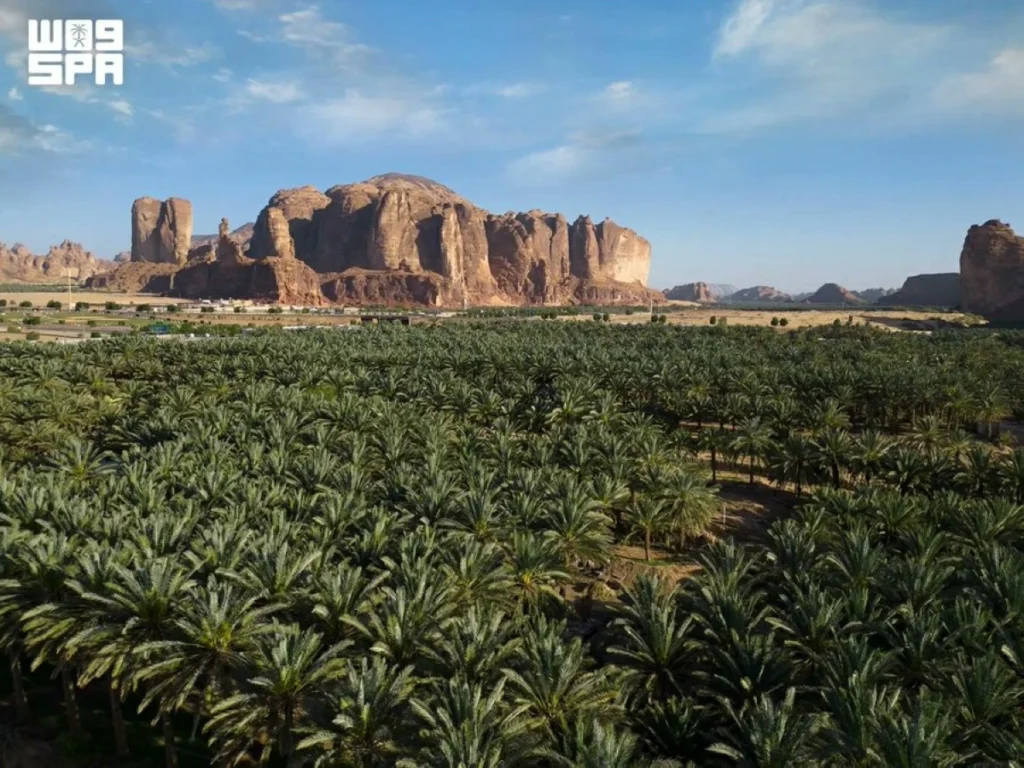
ALULA — Coinciding with the World Day to Combat Desertification and Drought, Saudi Arabia is highlighting its efforts to enhance biodiversity, restore natural ecosystems, and combat land degradation.
Among the Kingdom’s notable initiatives are AlUla’s environmental programs, which focus on rehabilitating natural rangelands and planting native vegetation to restore ecosystems and curb desertification.
The efforts have successfully rehabilitated more than 5,100 hectares of natural rangelands under habitat protection programs, as well as planted more than 530,000 seedlings representing 60 native plant species.
AlUla has also recorded notable progress in environmental recovery indicators, with vegetation cover increasing from 6 percent in 2018 to 35 percent in 2025.
The environmental efforts have also received international recognition through the inclusion of the Sharaan Nature Reserve on the International Union for Conservation of Nature’s Green List, in recognition of its biodiversity protection practices and management of natural areas in line with global standards.
As part of AlUla’s Ecosystem Restoration Strategy for 2025–2035, these achievements aim to restore and rehabilitate more than 65,000 hectares of natural rangelands and plant more than 10 million native seedlings, supporting the goal of achieving net-zero emissions by 2035.
The initiatives reflect AlUla’s commitment to adopting nature-based solutions to address desertification and land degradation, while contributing to ecosystem restoration and the sustainable management of natural resources.
In addition to AlUla, the Kingdom has achieved national milestones in combating desertification and drought across several regions.
The kingdom has successfully restored more than 8 million hectares of degraded land and planted more than 159 million trees across various regions, while the number of national parks has reached 540.
Saudi Arabia also operates three large desalination plants, with a combined production capacity of 150,000 cubic meters per day, and the National Afforestation Program has recorded an increase in the value of natural capital by SR6.4 billion.
The Regional Center for Climate Change Studies, the first of its kind in the Middle East, was launched, while the Regional Center for Sand and Dust Storms was launched as the world’s fourth center of its kind.
Other than plants and green spaces, more than 10 endangered native species have been reintroduced and rewilded, protected terrestrial areas now account for 18.1 percent of the Kingdom’s total area, and the area of protected marine zones has increased by 260 percent compared to 2016.
Source: Saudi Gazette