

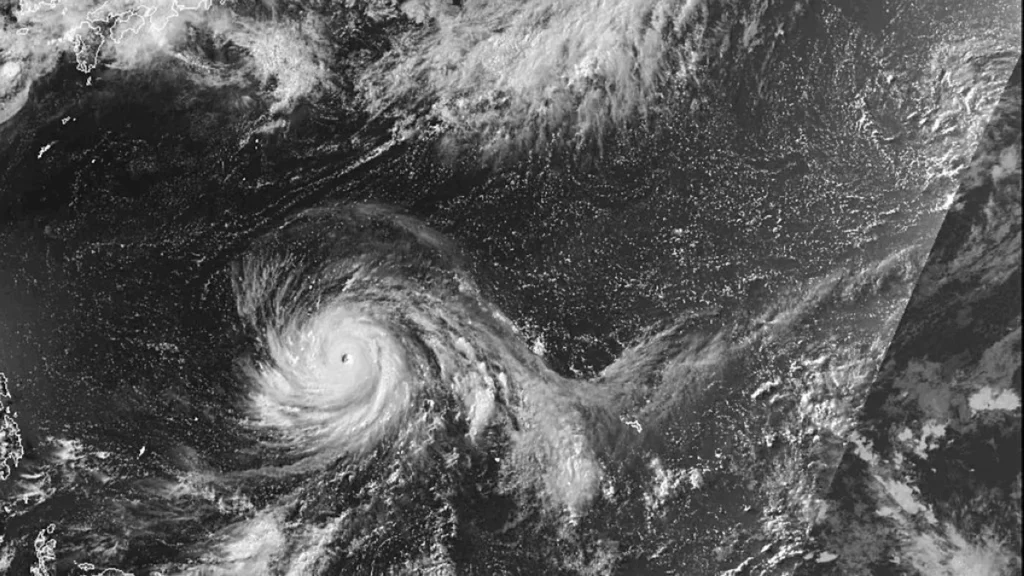
WELLINGTON — Super Typhoon Bavi made landfall Monday over a tiny US territorial island in the western Pacific, bringing powerful winds and torrential rain to the Northern Mariana Islands ofGuam, Tinian and Saipan, the US National Weather Service said.
The eye of the storm passed over the island of Rota Monday morning local time, bringing winds of more than 150 mph (241 kph). It was traveling at around 9 mph (14 kph) west toward the Philippines, the weather service said.
The service warned residents to take cover as the Category 5 storm moved through the island chain, parts of which are the US commonwealth of the Northern Mariana Islands and the US territory of Guam, about 3,800 miles (6,116 km) west of Hawaii and 1,550 miles east of the Philippines.
A cyclone becomes a super typhoon when it has maximum sustained winds of 241 kph or stronger, equivalent to a high-end Category 4 or a Category 5 storm.
Authorities on Rota said they had received reports of ‘major damage’ as winds of up to 290 kilometres per hour were forecast.
“We are experiencing heavy winds and flooding here… Some people already reporting major damages,” the Rota Municipal Operations Center’s public information officer Lou Rosario said.
Rosario added that some cellphone services were down because of a fallen tower.
The National Weather Service urged residents on X to “treat these imminent extreme winds as if a tornado was approaching and move immediately to an interior room or shelter NOW!”
“Hang tight,” National Weather Service meteorologist Brandon Aydlett said. “We’re coming just out of the peak of conditions. It’s going to be a slow improvement, but improvement is coming.”
Previously, the NWS had warned that a direct hit on Rota would make most of the island “uninhabitable for weeks, perhaps longer.”
“Many non-concrete, non-reinforced homes will be destroyed, with total roof failure and wall collapse,” it said.
“Nearly all trees will be snapped or uprooted and power poles downed. Fallen trees and power poles will isolate residential areas. Power outages will last for weeks to possibly months.”
Bavi posed an “imminent danger to life,” weather service meteorologist Edwin Montvila said, with the weather service telling residents across the islands to move to interior rooms and stay away from windows.
“Entering outside can result in death from flying projectiles. Utility poles and associated power lines will be down,” Montvila added.
In addition to Rota, typhoon and flash flood warnings were in effect for Guam, Tinian and Saipan, while tropical storm warnings and watches were in place for other islands in the area. The weather service said the storm could bring a total of at least 51 centimetres of rain by the time it passes through the region.
The Northern Marianas and the nearby separate US territory of Guam are collectively home to around 210,000 people. Some of the islands were still reeling from a previous typhoon, Sinlaku, that hit the region in April. Many people living in Saipan and nearby Tinian had been without power since the Super Typhoon Sinlaku.
When Sinlaku hit the island group, it caused widespread devastation, ripping off roofs, toppling trees and leaving tens of thousands without power.
Warmer oceans help tropical storms to intensify and add more moisture, which can fall as heavy rain.
The World Meteorological Organisation warned on Friday that El Niño, which typically occurs every two to seven years and lasts nine to 12 months, has already begun in the tropical Pacific and is likely to be strong.
The natural climate phenomenon warms surface temperatures in the central and eastern equatorial Pacific Ocean, bringing worldwide changes in winds, pressure and rainfall patterns.
Source: Saudi Gazette