

KYIV — Ukraine’s key European allies are working on plans with Kyiv to engage Russia in negotiations to end the war as they see a shift in momentum strengthening President Volodymyr Zelensky’s position.
Officials from Europe’s three biggest economies — Germany, France and the UK — have been discussing the possibility of holding talks involving both sides, according to people familiar with the matter.
They have also talked about the matter with their Ukrainian counterparts, said the people, who spoke on condition of anonymity to discuss private conversations.
The mediation efforts come as Russia’s air attacks have grown in sheer volume in recent months, hammering Ukraine with more drones and high-speed missiles than ever before, according to a CNN report.
The massive strikes are designed to overwhelm Ukrainian air defenses, with huge waves of cheap drones, then fast-moving ballistic missiles, then cruise missiles, coming in carefully planned succession to inflict maximum damage. Experts say that “overwhelm” approach allows more missiles to make it through.
The latest assault on Tuesday also included eight high-speed “Zircon” missiles – almost impossible to shoot down and powerful enough to take out aircraft carriers – the most ever used in a single attack, according to Ukrainian authorities. None of those eight hypersonic missiles were intercepted.
The barrage left 23 people dead and 151 injured across the country, Ukrainian authorities said. Beyond their immediate impact, experts say such attacks are part of a broader Russian strategy to sow fear among ordinary people and increase public pressure on Ukraine’s leaders to end the war.
A key factor in the increasing frequency and size of the air attacks is that “Russia is now really struggling to take any meaningful gains on the battlefield,” said Thomas Withington, an associate fellow for military sciences at UK-based think tank the Royal United Services Institute (RUSI). In April, Ukraine actually took back more land than Russia seized for the first time since 2024.
“I think that given this situation on the ground, the use of air power is possibly the only avenue actually now open to the Russian leadership in terms of hoping to have any kind of strategic effect on Ukraine,” Withington told CNN.
Earlier this year, Russia was launching roughly 5,000 Shahed attack drones each month. That increased to more than 8,000 last month, according to an analysis by the Center for Strategic and International Studies (CSIS), a think tank based in Washington, DC.
Although some of these drones get through, resulting in civilian casualties and damage to homes and infrastructure, analysts at RUSI and CSIS say that Ukraine’s air defenses are doing remarkably well considering the sheer size of Russia’s attacks.
Ukraine has retained roughly the same interception rates for drones as before the recent escalation, downing around 90% of them each month and using electronic warfare to divert some munitions away from populated areas.
But Ukraine is having more difficulties with intercepting ballistic missiles and the hypersonic “Zircon” missiles, both of which move at incredibly high speeds and require more advanced interceptors to take them down.
Tuesday’s attacks across Ukraine included 41 ballistic missiles – more than the number launched by Russia throughout the whole of last month. Thirty of those made hits. That comes as Ukrainian President Volodymyr Zelensky told CBS News that Ukraine is only getting about 60 to 65 interceptor missiles each month, given production constraints.
“There aren’t enough missiles for the Patriot system; a great many were used in the Middle East,” Ukrainian Air Force spokesman Yurii Ihnat told CNN on Tuesday, in the aftermath of the heavy overnight bombardment. “Another factor is how the enemy deploys missiles – that is, they use ballistic missiles specifically against regions that are less well-protected against such strikes.”
Experts said that given finite defense resources, the capital, Kyiv – a main strategic target and the seat of government – would be expected to be better defended than other regions and less populated areas.
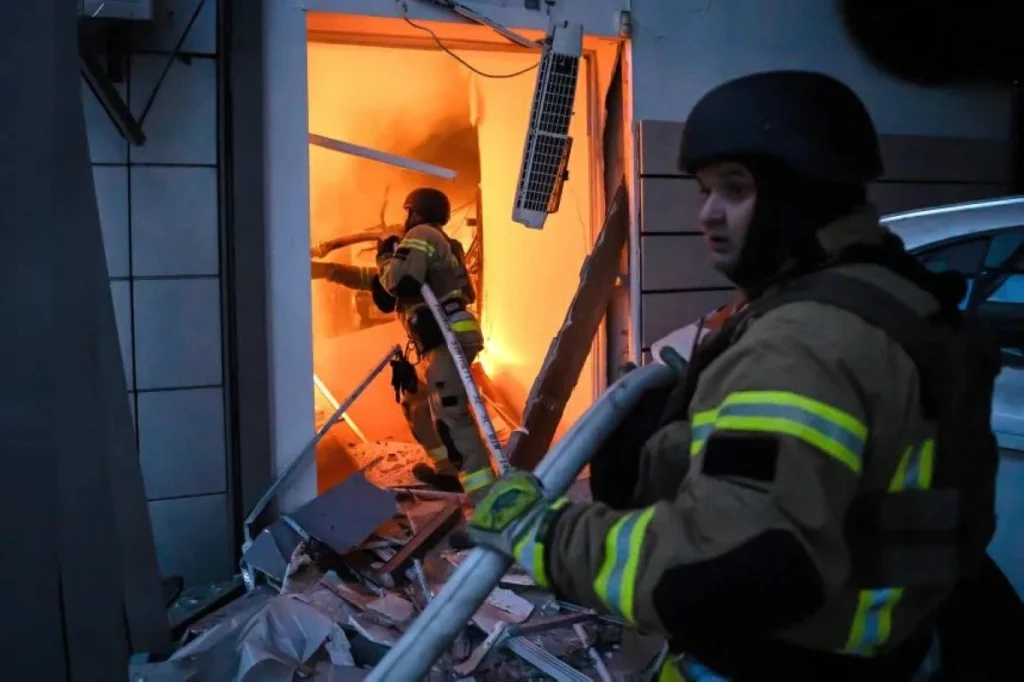
Russian munitions that did make it through on Tuesday damaged several high-rise residential and commercial buildings in Kyiv, sparking fires and burning cars on the streets. Some military infrastructure was also hit, the Russian Ministry of Defense said.
Perhaps alarmingly, the city’s air defenses appeared to be less active during the final wave of Russian strikes on Tuesday morning.
Elsewhere in Ukraine, the salvo caused numerous casualties in the city of Dnipro and struck energy facilities in the Kharkiv region, authorities said. At least one strike was a so-called “double tap,” killing a firefighter in Dnipro as he responded to a previous wave of attacks.
Ukraine’s Commander-in-Chief Oleksandr Syrskyi ordered the Ukrainian military on Wednesday to improve its air defense command and control systems, also highlighting that the country is operating under “a shortage of modern air defense systems and missiles for them.”
Zelensky, who has repeatedly warned that the country’s inventories of US-made Patriot defense systems and their PAC-3 interceptor missiles are extremely limited, once again appealed to allies for more supplies.
“Europe needs its own anti-ballistic capabilities so that this war can finally end. And we absolutely need the United States’ help in supplying missiles for the Patriot systems,” Zelensky said in a statement.
Source: Saudi Gazette