

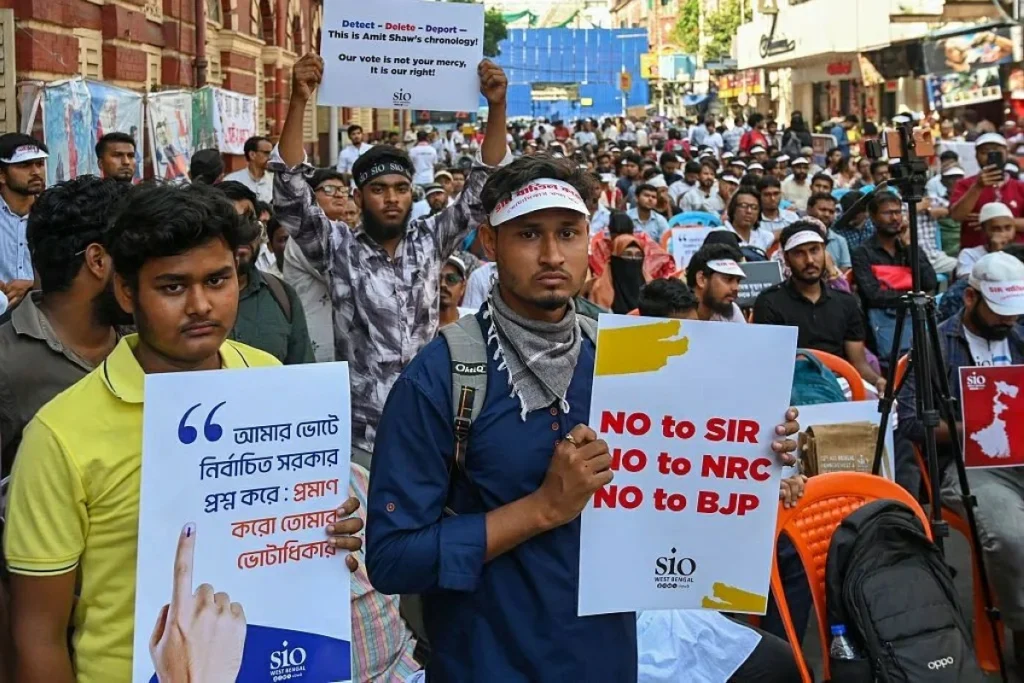
KOLKATA — Millions of Indians have begun voting in high-stakes elections in India’s West Bengal and Tamil Nadu states amid controversy over a sweeping revision of electoral rolls that has heightened political tensions.
Millions of people in India were stripped of their vote ahead of the critical state elections after a controversial electoral revision described by critics as a “bloodless political genocide” and mass disenfranchisement of minorities.
In West Bengal, where the fiercest contest is unfolding, a total of 9.1 million names have been deleted from the register, more than 10% of the electorate. While many were dead or duplicates, about 2.7 million people have challenged their expulsions, but still been removed.
The process of revising the electoral roll, known as Special Intensive Revision (SIR), has been taking place in states and territories across India, justified by the Narendra Modi government as a way to stop “infiltrators” – a pejorative term largely referring to illegal Muslim Bangladeshi immigrants – from voting.
The divisive exercise by the central Bharatiya Janata party (BJP) government to “purify” the electoral roll – in the words of home minister Amit Shah – has led to a chorus of fury.
Voting is under way in 152 of 294 seats across 16 districts in West Bengal in the first phase, with 1,478 candidates in the fray. A second phase of polling is scheduled for next week.
Modi’s Bharatiya Janata Party has mounted an aggressive push to unseat Chief Minister Mamata Banerjee, whose Trinamool Congress is seeking a fourth straight term in a state the BJP has never governed.
In Tamil Nadu, elections are being held in a single phase across all 234 constituencies, with more than 57 million voters eligible to vote.
These elections are part of a wider round of state elections seen as an early gauge of support for Modi’s party, with polling already held this month in the states of Kerala and Assam and the federally-administered territory of Puducherry.
For the BJP, the contests are a test of its ability to expand in regions where it has struggled, while opposition parties are gauging whether they can challenge its dominance.
About nine million voters — roughly 12% of the state’s electorate — have been removed following a Special Intensive Revision (SIR) exercise, with officials saying millions were classified as absentee or deceased, while the status of another 2.7 million remains under review.
While tribunals in West Bengal continue hearings on more than three million appeals from people removed from electoral rolls, 139 voters were cleared for inclusion in the first round of polling at the last minute, according to reports.
India’s Election Commission says the exercise aims to clean up rolls, but it has been mired in controversy and legal challenges since it was first carried out in Bihar last year.
Thirteen states and federally-administered territories have undergone the SIR process so far, but West Bengal is the only one where it was followed by an additional layer of special adjudication.
The issue has raised concerns among affected families, some of whom say their names were struck off despite valid documents, leaving their eligibility to be decided by tribunals even as voting proceeds.
Tensions have been fuelled by political remarks, including from Modi, suggesting the voter roll “clean-up” targets so-called “illegal Bangladeshi infiltrators” — a term the Trinamool Congress says is being used to refer to Muslims. However, officials say many Hindu voters have also been excluded from the list.
Security is a key focus, with a record deployment of about 240,000 central forces across West Bengal, supported by bulletproof vehicles patrolling poll-bound districts.
The scale reflects concerns over electoral violence and intimidation in a state with a history of politically charged contests.
Ahead of the first phase of voting, the Election Commission imposed strict curbs to ensure security, including a ban on bike rallies, pillion riding during the day and non-essential two-wheeler movement at night across 152 constituencies.
The restrictions, in force from Tuesday, also include a 96-hour liquor ban – longer than the usual 48 hours.
The revision of electoral rolls, large-scale reshuffle of state government officers and heightened security measures have become particularly contentious in a state where the ruling party is locked in a bitter stand-off with the election authorities.
Thursday’s polling will cover seats largely in the farthest reaches of West Bengal — the northern, central and southwestern belts, which are among its less prosperous regions.
These areas also have a higher share of Muslim, tribal and lower-caste Hindu populations. West Bengal is home to India’s second-largest Muslim population, accounting for roughly 14% of the country’s 172 million Muslims, according to the 2011 census.
All three of the state’s Muslim-majority districts — Murshidabad, Uttar Dinajpur and Malda — go to the polls in this phase.
The constituencies also account for a larger share of the 2.7 million voters removed from the rolls over “logical discrepancies” in their records.
The second phase of polling on 29 April covers 142 seats, largely in and around the capital, Kolkata, and the lower Gangetic plains of south Bengal, a region that has remained a stronghold of Banerjee’s TMC over the past three elections.
Beyond West Bengal, attention also turns to Tamil Nadu, where politics has long been dominated by two regional parties — the Dravida Munnetra Kazhagam (DMK) and the All India Anna Dravida Munnetra Kazhagam (AIADMK) — both rooted in social justice movements.
The state is currently governed by MK Stalin-led DMK, while the AIADMK is contesting in alliance with the BJP.
This year’s contest has drawn added attention with the entry of actor-turned-politician Vijay and his Tamilaga Vettri Kazhagam (TVK), raising the prospect of a three-way race.
The BJP has historically struggled in the state, where politics is shaped by regional identity, linguistic pride and welfare-driven policies. — Agencies
Source: Saudi Gazette