

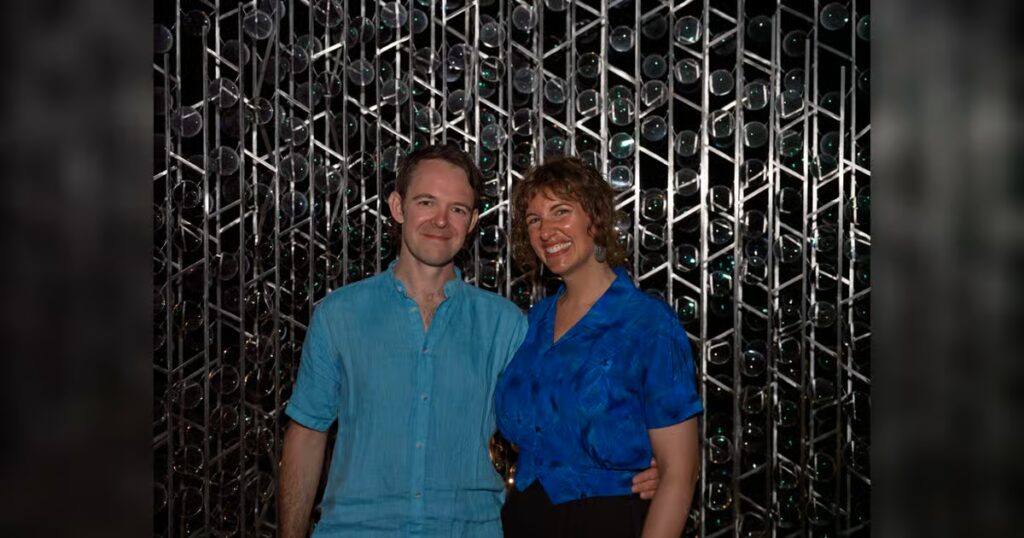
We are in Crete, that most mythical and magical of Greek islands where, according to ancient legends, the god Zeus was born. On one side lies the great cerulean expanse of the Mediterranean sea and on the other, stands the picturesque village of Agios Nikolaos. Artists Caitlind R.C. Brown and Wayne Garrett — who are also a couple in real life, they quickly clarify within minutes of introducing themselves — have just returned from a swim in the ocean.
Nothing adventurous to report? Oh wait, they spotted a baby shark in the waters. Aptly enough, Steven Spielberg’s Jaws is invoked. But soon guests and art pilgrims start trundling in and all eyes swiftly turn to Brown and Garrett’s new commission, Chronotopia.
Installed at the influential Greek art patron Gina Mamidakis’ Minos Palace Resort in Crete, Chronotopia looks out into the Mediterranean sea with glee and as a piece of interactive art, it demands that you engage with it. The title Chronotopia combines the Greek terms, chrono (time) and topos (space) but Brown insists that she likes the neologism for another reason — its phonetic similarities to her favourite word, “utopia”. How about Chrono-utopia, then, a dream combo of time and space in a galaxy far, far away? We laugh heartily.
Made using hundreds of discarded optical lenses, Chronotopia is a meditation on the illusion of vision and perception, urging us to embrace multiple perspectives because the nature of reality is complex and there’s no singular way of seeing the world. There never is. Based in Calgary (Canada), Brown and Garrett have a soft corner for found objects, especially prescription eyeglass lenses and they have produced a series of similar sculptures before in Japan, China and Turkey.
“When used as a sculptural material, prescription eyeglass lenses become devices for re-seeing, a shift in focus that evokes human vision, while simultaneously feeling organic (like rain, water, or light). In this sense, lenses are at the intersection between people (and our ways of seeing) and the natural world,” argued Brown.
Chronotopia marks a major milestone in the pair’s over decade-and-a-half long career. In June, this human-scale installation was chosen as a winner of this year’s prestigious G. & A. Mamidakis Foundation Art Prize. Earning the Art Prize was admittedly an unexpected twist in the trajectory of their art practice. Now in its sixth year, the Mamidakis Foundation has always sought proposals for its Art Prize to integrate organically into the Cretan landscape.
The prize was envisioned by its founder, the renowned Greek hotelier Gina Mamidakis, as a creative environment where artists could express themselves freely and support would be provided with genuine passion. She started with a pioneering art symposium in the late 1980s which eventually evolved into the Art Prize — in the process, Mamidakis also ended up amassing an enviable collection of contemporary art. Though Brown and Garrett had never visited Crete before applying, they explained that the island’s quintessential light, space, water and blue horizons mesmerised them from day one. Crete, then, became an ideal backdrop for their work.
“We were drawn to the Prize not because it was an award, but because it was an opportunity to create a site-responsive artwork in the context of Crete,” said Brown, whose work will now join G. & A. Mamidakis Foundation’s permanent collection which includes such art-world heavy hitters as Lynda Benglis, Costas Varotsos and Danae Stratou, to name a few.
Crete has always loomed large in their collective imagination. They described themselves as “mythology-obsessed kids” who grew up with fanciful dreams of Greek gods and goddesses. “Even in photographs you can tell this island is haunted by heroes, gods, and epic tales. The ever-changing sea is so powerful and primordial — much bigger than we are as creatures of blood and bone. Chronotopia came from the desire to collaborate with the striking landscape of Crete. In this way, we started with the place, expanding outwards into an optical form that would envelope the viewer within place and time,” Brown shared.
Perpetual Nowness of Being Alive
Brown and Garrett belong to that select group of avant-garde artists who thrive by operating outside the traditional art ecosystem. They have carved a niche for themselves, thanks to an unconventional approach that sees them often exhibiting in alternative spaces, ranging from public libraries and public parks to forests, parking lots and abandoned buildings. Which is why Greece was an unusual conquest for them. To critically engage with a very different crowd of art lovers, journalists, thinkers, curators and historians offered them new perspectives about their own work and its place in the world. “The opportunity to present our work in this arts-specific context feels like a bridge between the site-responsive work we are already making, and the larger discourse surrounding contemporary art now,” said Garrett.
The couple, who began their careers producing experimental films, often work on projects that combine technological sophistication and scientific rigour with poetic sensitivity. Like Chronotopia, their recent, shimmering lens-based artwork Conversations with Time was showcased in an ancient forest for the Setouchi Triennale in Japan while Light Keeper was an analogue rainbow projection machine they made in collaboration with Studio North in Toronto. Despite permanent works like Yesterday, Today, Tomorrow, A Whisper in the Eye of the Storm, Tears of the Moon and Play it By Ear, their best known creation remains Cloud. This interactive light sculpture was originally made in Calgary but has already toured over 40 countries since 2013. “We sometimes think of this artwork as engaging with the perpetual nowness of being alive,” laughed Brown, who’s the more animated of the two.
Weighing in on their creative process, she explained, “Whenever possible, we work with analogue materials because they are more timeless and reliable. We like it when the viewer is able to figure out how the artwork was made, deconstructing our process in their minds. One might think this could reduce the magic, but we find that it simply demystifies our approach, allowing more access points for curious people.”
Brown and Garrett are something of a “curious/hyper-imaginative” couple themselves. For them, the creative act is not simply about placing an object in a space and leaving it at that, like most artists do. It is more about transforming the space itself — slowing time down and gently guiding strangers towards a shared spatial experience. They have long resisted the idea of public art as a static monument. Their practice instead is activated through chance encounters.
Installations that ask visitors to linger, participate and rethink their perceptions of what art can achieve. It often seems like their installations become gathering places where conversations emerge naturally between total strangers. People sit still, wait, watch, agree, disagree, find common connections and experience the joys and uncertainties of the world together. It was Marcel Duchamp, the father of conceptual art, who first propagated the idea of audience participation in the 20th century visual arts, famously emphasising that while the artist creates, “the viewer completes the artwork”.
The Meaning of an Artwork
“The ability to enter any work and sit in it is an intimate invitation, isn’t it?” asked Garrett. Speaking about audience participation, Brown said, “To be felt, art needs to be experienced. We specialize in art that relates back to the human body, inviting the viewer to participate in a gentle, but active exchange. Sometimes this participation involves touch, other times it involves looking or listening in a more immersive way than traditional artworks allow. Without YOU, the art does not exist.”
Despite coming from different backgrounds, Garrett and Brown appear to be completely at ease as partners in both creativity and life. Garrett trained as a musician and even today finds a certain lyricism in art, while Brown is a graduate from the Alberta University of the Arts who started making experimental cinema in early 2010s. They met through a local subversive arts collective, collaborated on films together and soon discovered that they were made for each other.
As to why they moved away from their cinematic roots, Garrett said, candidly, “We grew frustrated with the finite time-scale of filmmaking, and started turning these films into projection-based sculptures, which slowly evolved into light art, then immersive sculpture. In this way, the artworks were released from cinematic time, and cast into the ever-flowing river of physical time as it unfolds around us, always.”
Perhaps for this reason, they think of their viewers as co-performers. According to their logic, the artist and audience walks away hand in hand into the civilisation sunset together — though before jumping into the participatory bandwagon, Caitlind R.C. Brown and Wayne Garrett would likely prefer one last dip in the Mediterranean’s blue waters. And this time, they are expecting the “mother shark.”
Source: Khaleej Times