

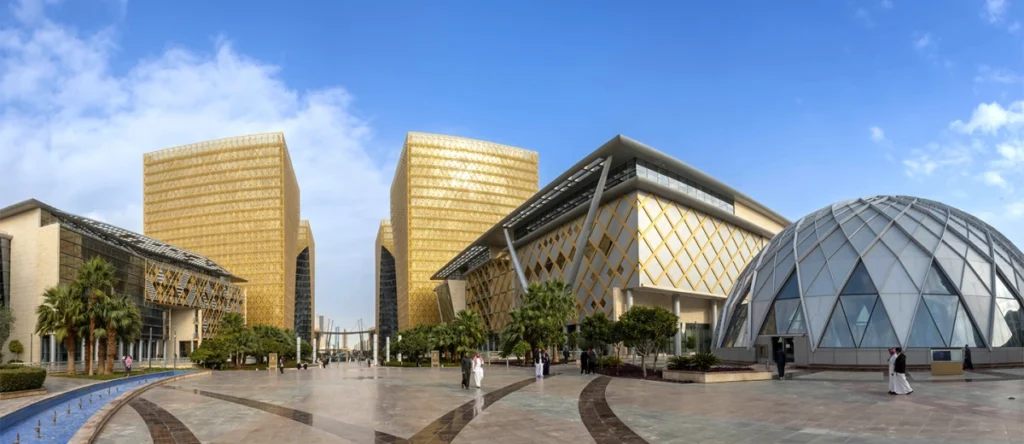
RIYADH — The first batch of students began their first semester as the classes commenced on Sunday at the Riyadh University of Arts. The university opened its doors for admission and registration in May following a royal order issued by Custodian of the Two Holy Mosques King Salman approving the establishment of the Riyadh University of Arts in March this year.
The opening of the university is considered as a historical milestone in the journey of culture and arts in Saudi Arabia, and that embodies the state’s directions towards investing in human capital and the creative economy, as well as enhancing the Kingdom’s cultural presence at the local and international levels.
Minister of Culture and Chairman of the Board of Trustees of Riyadh University of Arts Prince Badr bin Abdullah revealed that the university has received thousands of applications across its cultural programs and academic degrees ahead of the start of its first classes. Writing in Asharq Al-Awsat, Prince Badr said the strong demand had emerged since registration opened for the university’s first-year programs. “The university has started big in its ambition, bold in its objectives and firmly grounded in its foundations: a Saudi identity with global standards,” he said.
Prince Badr said Ministry of Culture projections indicate that demand for cultural jobs is expected to grow by more than 7 percent annually, with employment across Saudi Arabia’s cultural sectors projected to reach about 346,000 jobs by 2030.
He also pointed to broader regional trends, saying demand for jobs in arts, technology and design is growing by 40 percent annually in the Middle East, while cultural tourism grew by more than 109 percent between 2019 and 2022.
Prince Badr said Riyadh University of Arts aims to become a leading specialized cultural university in the Middle East and North Africa and rank among the world’s top 50 universities in the cultural field.
The university also seeks to establish itself as a global center for academic education, scientific research and cultural and knowledge exchange, connecting Riyadh with the wider world.
Prince Badr said human capability development initiatives have accounted for more than a quarter of all initiatives undertaken by the Ministry of Culture and its cultural commissions over the years.
More than 63,000 people have benefited from education and training programs across different cultural sectors since the Ministry of Culture was established in 2018, he pointed out.
The university’s academic programs cover a wide range of cultural and artistic disciplines, including cultural management, filmmaking, music, museum management, theater and performing arts, design, architecture, fashion, visual arts, photography, heritage and cultural studies, culinary arts, and cultural education.
The university campus is located in Riyadh. At present, students have been enrolled in four initial colleges and eight academic programs across the College of Music, the College of Film, the College of Theater and Performing Arts, and the College of Cultural Management. It will then gradually expand to 13 colleges offering diverse educational programs covering various cultural fields and sectors.
The university has recently established partnerships with leading international institutions. It will empower artists, researchers, and cultural leaders to drive the creative economy and the Kingdom’s cultural future. The university will be an independent educational institution under the supervision of the Ministry of Culture.
Source: Saudi Gazette